If the title doesn’t give it away, MacDonald lovers, we’re discussing Cairo, or the time period surrounding the making of it, anyway. You know, a while back, Cairo was on my mind as a topic for a fun blog post, discussing all the Easter eggs that are in it (omg so many) – and maybe I’ll get back to that eventually, but what has actually happened is that the spring and summer of 1942 has me in a chokehold and I haven’t been able to concentrate on anything else in my efforts to work this out in my mind. Please settle in and stick with me, this is a long one.

As usual, there’s approximately 49 versions of what all went down in the lives of Jeanette, Nelson and Gene during this time. I have made many pages of notes and compared data across multiple source texts, published and not, including Jeanette’s autobiography manuscript in various versions, her business and personal correspondence as well as published and unpublished wartime letters between her and Gene, cross-referenced between Sharon Rich’s Sweethearts (full of so much information and the most heart and soul; awaiting the forthcoming and necessary updated edition) and Edward Baron Turk’s Hollywood Diva (which I’ve come to regard as a handy academic summary of Clara Rhoades-scrubbed data and little more) and Maggie McCormick’s I’ll See You Again books (which read like a well-mannered book report, with the author alternating between adjusting every dollar figure for inflation and needing to explain the mildest sexual innuendo for the class as though every reader is as sexless as the general membership of the now-defunct JMIFC, lol — still a handy date reference). It’s a real blessing to have so much additional material at my disposal so that I can try to cobble together what really happened between warring books and factions of fans, censored materials and deliberate omissions, or at least, ask pertinent questions. The bottom line is, there’s a large crossover where everyone’s kind of right and at the same time, everyone has missed stuff. I certainly don’t purport to have it all correct now, but I can at least make an assessment of the available material and try to create a through-line.
Let’s begin.
I Married an Angel officially “wrapped” just before Christmas, 1941, with retakes extending into January. This, in theory, left both Jeanette and Nelson with one remaining film each to make in order to satisfy their existing MGM contracts. Two people who worked on the set of IMAA reported Mayer showing up in person during shooting and making a scene, causing Nelson to announce that he was quitting and walk off the set. While I don’t doubt that this is true, and Nelson certainly had no great love for Mayer, in my opinion, additional context is needed. With Pearl Harbor bringing the US so newly and officially into the war and Woody Van Dyke embroiled in the battle with cancer that would eventually result in him taking his own life the following year, and both Jeanette and Nelson’s frustration with the stupidity of the material (both would denounce it without reservation for the rest of their lives) and eager to be doing important work related to the war, it’s entirely likely that the vibe on the set was weird anyway, and Mayer’s appearance and subsequent rudeness just was the straw that broke the camel’s back. Regardless, Nelson didn’t quit, not then, anyway, and completed the picture. Between finishing IMAA and leaving for his concert tour on February 7, he recorded twenty-two songs for Columbia Records (Sweethearts cites Jan 18-Feb 2 as his recording dates). He would return to Los Angeles following his final tour stop on April 22.
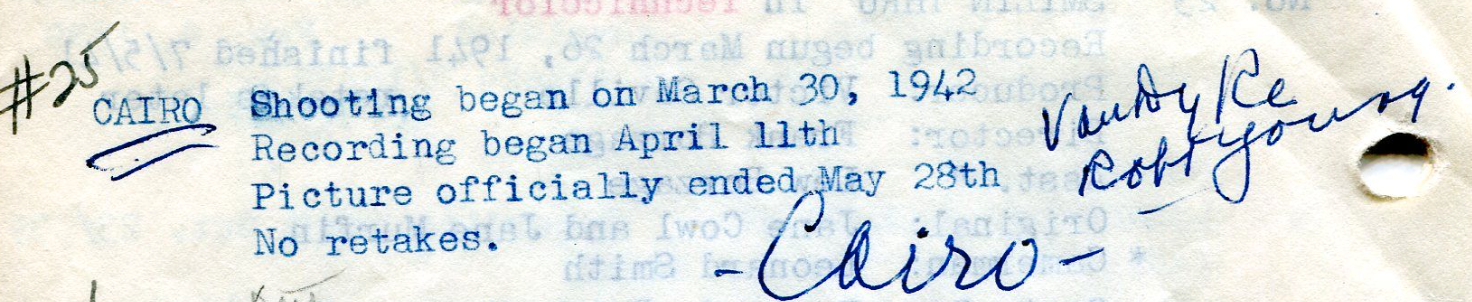
Jeanette elected to finish her contract with the comedy Cairo, which wasn’t initially super well-received but I don’t know a single fan in the year of our lord 2026 who doesn’t like it. She got Bob Young to costar, with whom she got along well, and got to kick the thing around with Woody Van Dyke one more time, on his second-to-last film. Yes, it was a cut or two lower than her MGM standard, but it has aged well, and shows what a really fantastic comedienne she was. I’ve read that she pushed for more patriotism which would account for the medley in the middle of the movie, and while I can’t absolutely verify that offhand, it sounds like her and I’d like to think that’s true, especially given that that’s one of the things that elevates the material, something Jeanette was always striving for. According to Jeanette’s personal paperwork, Cairo went into production March 30, though I’ve also seen it published that it started April 1. Cairo wrapped four days under schedule on May 28th, and, thanks to Woody Van Dyke, under budget as well. After completing Cairo, Jeanette was offered another MGM contract, which she ultimately did not take, since she was not happy with her most recent vehicles. More on that later.
Gene Raymond learned to fly right after Hitler invaded Poland, and was poised and ready when his services were needed. He departed for Washington, DC, on March 13, for Air Force training, from which he would graduate on May 23. Though it has been published (I’ll See You Again) that he had a five-day furlough, in one version of her autobiography manuscript, Jeanette made a handwritten note that said “ten day leave” and this actually makes more sense, since he went home to Los Angeles, returned east (with Jeanette at his side, surprising him by willingly flying along to see him off) May 29, and, though he was supposed to ship out June 2, wound up actually leaving for England on June 3. Jeanette’s number is correct.
Marge Halford, who, with husband (Dr.) Pete, were friends of Jeanette’s dating back to her first trip to Hawaii in 1935 (and who owned the cottage where Jeanette and Gene honeymooned), had to evacuate Honolulu following Pearl Harbor, landed at Twin Gables for a couple of weeks to visit with Jeanette , without her husband but with her three children (a fourth was born after the war). Reportedly, the Halfords arrived at Twin Gables while Jeanette and Gene were in New York, and daughter Joan reportedly recalled going to the studio with Jeanette to watch her shoot retakes on Cairo, and remembering how long it took to do one scene (even with One Take Woody at the helm??) but this is curious because more than one source, including Jeanette’s personal papers, say there were no retakes on Cairo. The Halfords’ visit is referenced in multiple letters, so they definitely were there, but something about that anecdote doesn’t work, either with the timing, the memory itself, or the reporting of same.
When the Halfords left, Anna MacDonald, Blossom and Rocky were supposed to move in, in keeping with the idea that Jeanette would need company in the house. But let’s unpack this: on a letter from Gene dated June 24th, he asks her if her mother has moved in with her yet, and doesn’t say “and your sister” or “has your family moved in” — but I don’t think Blossom and Rocky really did, because I can’t find further indication that it happened at this time, only that it was the plan at one point for them to do so. Jeanette and Gene had purchased a little over a hundred acres of farmland in Temecula before the war, and from the letters, it seems that Blossom is very occupied with trying to figure out what to do with it. It didn’t have anything but the most rudimentary house, and wartime shortages wouldn’t allow for anything much in the way of new construction (when the horses were moved off the Bel Air property, the interior stalls and partitions of their barn and the dog kennels were gutted and the lumber was to be repurposed on the farm). As a farm girl myself, I’m really rather perplexed as to why poor Blossom was stuck in the role of farm manager when I’ve seen no evidence that this Philadelphia/New York/Hollywood girl knew anything about same, but here we are. She does seem to be in Temecula an awful lot around this time, and on one occasion Jeanette is there with her, but maybe she’s in and out from Temecula to LA? I don’t know. Tires were the first thing to be rationed in January, and of course fuel was as well, which may indicate she was staying there instead of commuting. Rocky had a job in the city and may not have been able to live back and forth in Temecula, which would account for him not being mentioned in conjunction with Blossom’s presence at the farm, but would he really want to live with his sister in law and mother in law without his wife? Further, a couple of sources mention that Jeanette wanted to find a tenant for Anna’s house (which she owned) and was unable to do so — so does this mean they let it stand empty? Or did Anna actually in fact not move, at least until later? Finally, in a letter from Gene dated August 19, he states that he’s glad the family is with her, so it’s possible that this didn’t happen until after her Army Camp tour (which ended August 11), or, with wartime mail delays, maybe they moved in while she was gone. This all warrants further investigation, but I’ve reached the end of what I can do with this information at this time. I do know that nothing ever really became of the Temecula property, and eventually they let it go.
Now that I’ve given you a picture as complete as possible as to what all the major players were up to around this time, let’s add in a very interesting complication.
When Gene was home on his furlough at the end of May, Jeanette was experiencing “violent indigestion” as well as “heart murmurs”. In notes for one version of her autobiography manuscript, she indicated that these symptoms were not just nerves about Gene going to war; she was pregnant.
(A note here about how legions of folks always rather dismissively claimed she couldn’t get pregnant, despite obvious physical evidence in 1938 and many claims to the contrary: don’t believe everything you’re told, first of all, and secondly, the old JMIFC faithful really have a mighty self-righteous sense that they “KNOW” things because they were fed information from Clara or Emily. Has it not occurred to anyone that Clara was not a true intimate by a long shot and was on a need-to-know basis about most things — and Emily wasn’t about to divulge Jeanette’s personal business? Gosh.)
She couched this (for her book) as a happy wartime event, saying she planned to write Gene and tell him that, should something happen to him, a piece of him would live on (okay, Jeanette). It seems (and has been published) that in April of 1964, when she was once again trying to get something going with this book, literary agent Russell Case suggested that she remove or edit this information. Why might he do that, since it’s one of very few really personal things she wrote (at least in any version of this project I’ve ever seen)?
Because the math is not mathing, to a discerning eye. It’s the same problem as so much of her book, and in my opinion it’s why it was never published. Jeanette had an easy interview “stance” that the publishers wanted her to fill her book with dirty details and because the pious MacDonald had nothing “particularly sordid” in her life, this was impossible. I love her beyond all reason, but she’s full of shit with this, and I don’t buy that the publishers were trying to get her to add “dirt” — they were trying to get her to tell a complete goddamned story! They said her book was off-balance, because the childhood and early life is good and as soon as she gets engaged to Gene it’s a race to the finish — at one point she was advised to cut some of the early stuff and add more of the Hollywood stuff, which only makes sense! It’s WILDLY obvious that there’s an absolute motherlode she’s not talking about, and it is not viable; very short on Hollywood stories; very thin on Nelson Eddy anecdotes (which is what Joe Public would have been most interested in), hardly anything about her radio work, television, etc. Hardly any fun or memorable recollections colored vibrantly with names from Hollywood’s Golden Age. In one version it’s 92 pages from her getting engaged to Gene to the end of the book, which means less than one third of the manuscript is all she allows to detail her life from 1936 on. My firm belief, in the final analysis, is that she was unwilling to deny Nelson’s powerful, lasting and incredibly significant presence in her life, and she was unable to “let it all hang out” and deal with the fallout, scandal and general commotion at this time, when her health was beginning to fail, and the idealistic loyalty of her fans kept her going. But enough about the book, this pregnancy revelation is important. Let’s quickly revisit the timeline:
Gene is away on the East Coast for training from March 13-May 23/24. Jeanette is in LA making a movie.
Gene is home for the last week of May, and Jeanette is experiencing pregnancy symptoms, which she confirms after Gene has left (June 3), because she notes that she was going to write to him.
Jeanette indicates that she lost the baby “many weeks later” — yet she leaves for her tour of army camps on July 18 and returns home August 11, with photos giving no indication that she’s pregnant.
The major problem here is that morning sickness symptoms typically start between 4-6 weeks of pregnancy.
Gene was not around to get her pregnant during that timeframe.
If he had gotten her pregnant, let’s say in March right before he left for training, she would be eleven weeks pregnant (at minimum) — and she would certainly know she was pregnant and there would have been no need for her to note that she was going to write him; surely she would be seeing him off to war with that news tucked romantically into his heart. (Except he didn’t like children and didn’t want them, and had, as she put it, a “cold shell” around him that she couldn’t seem to melt, but that’s another story, as is Jeanette’s declaration upon returning from her honeymoon[!!] full of a foreboding knowledge she seemingly didn’t have before the wedding, that “the MacRaymonds had no children.” Jeanette longed fervently to be a mother, but found out on her honeymoon she wouldn’t be having children with her new husband. But she’s pregnant in 1938. And she’s pregnant here, in 1942.)
If Gene got her pregnant in May when he was home, she wouldn’t have symptoms yet, not the same week of conception.
It’s worth recalling, at this juncture, that Mr. Eddy returned to Los Angeles immediately following his final concert on his tour, which was April 22. He’d been gone since February; an intimate reunion upon his return could have nicely yielded a five week pregnancy just in time for those symptoms at the end of May.
It would explain a lot. Thus far, from multiple corners of the earth, no wartime correspondence has surfaced during which the Raymonds exchange even one word that remotely smells like a pregnancy. Jeanette’s assertion that she lost the baby “many weeks later” would surely have led to Gene’s inquiring about how she’s feeling, or how she’s holding up, or some sort of interest in her health or mental state as it relates to losing a child. Yet there’s not a word. The closest he comes, other than a general “take care of yourself” type sign-off in many letters, is expressing regret in one letter that she’s dealing with a persistent bladder infection. This explanation would not only satisfy the lack of correspondence about it (censors or not, they’re a married couple and this is certainly fair game for discussion, nothing scandalous about it), but would also explain why Emily wasn’t either in the loop or willing to speak on it years later.
I believe she lost this pregnancy before beginning her Army Camp tour on July 18. That could still qualify as “many weeks” since figuring out she was pregnant, and I have several reasons for thinking that this lines up. Firstly, I really cannot envision her doing the Camp tour pregnant. Reverting back to the earlier timeline, if this was Gene’s child conceived in March, she would be 19-20 weeks along when starting this tour. That’s halfway. On her slight frame, and especially given that this wasn’t her first pregnancy, she’d be showing quite obviously, and it makes it hard to fathom that she would be enjoying the officers’ swimming pool as was noted on one stop during this tour.
That aside, the work itself, through the “heat belt” was so damningly hard, and she was singing 33-36 numbers per concert, her accompanist passed out from the heat at one point, she was traveling light and often alone, including driving part of the tour in a Ford. I find it absolutely hard to believe that a pregnant movie star would be doing this in 1942. It’s possible that she would have tried it if this was a baby conceived in late May, because she would be in her seventh week of pregnancy starting the tour, and she may have thought she could get away with that, however, this theory doesn’t work because it negates her late May symptoms.
Again, the thing that makes the most sense is that she conceived in late April without the aid of Mr. Raymond, and miscarried in early July before beginning her tour. That would have put her roughly at 10-11 weeks of pregnancy, if my theory holds of the baby being conceived sometime in the first couple days of Nelson’s homecoming, which correctly lines up with her morning sickness symptoms at the end of May. Not only is that scientifically sense-making, it is suspicious given the next set of circumstances I’m going to put forth:
I mentioned above that Jeanette was offered a 1942 MGM contract, once her existing contract was fulfilled with Cairo. There were a couple discussions surrounding offers from other studios, which eventually either went cold or were turned down; she did not accept the new Metro contract, and eventually packed up her dressing room and moved out. The consensus of opinion is that this happened over the summer, after she finished Cairo. What I cannot nail down for love or money, from any source, published or not, is the actual date she left. The date she told them no, the date she cleaned out her dressing room, anything would be better than what we have now, which is a vague “over the summer.” I am ASSUMING that this took place in June or July, but I don’t have that date. If anyone does, please enlighten me.
Here’s where this gets [more] interesting. Earlier I mentioned Nelson threatening to quit during the filming of I Married an Angel, and indeed, rumors to this effect were spreading around the trades. He didn’t actually do it, not right then, and one source claims that it was Jeanette who settled him down and got him to agree to at least let the situation chill while he went on his spring tour. MGM in fact had another property lined up for Nelson, entitled Lucky Star, pairing him with the young Kathryn Grayson. According to Sweethearts, Nelson received his script on July 3 (the script is in the Nelson collection at USC, and MGM scripts had dates on the front), and was obviously considering doing it and fulfilling his contract, because he made notes in it about his dialogue and line delivery. However, on July 29, the New York Times published that he had bought out his contract.
So something happened in July. Could it be that Jeanette was considering the new MGM contract (even though she wasn’t happy with the last few movies), and as such Nelson was going to stick it out, make the money (which he would need to divorce Ann or otherwise make moves since Jeanette was pregnant), keep his options open and perhaps also entertain a renewal? If I’m correct and she lost the baby in early July, that could have changed everything for them, including these plans. At that point, it likely made the most sense to be finished with MGM, and be free to figure out their next tandem move. One thing about Nelson; history shows us that he wasn’t doing any contract signing with MGM that Jeanette hadn’t done first. Makes total sense that he would go along with the program (once he had cooled down) until she had played her hand with the studio.
An amusing (to me) postscript about the MGM situation, is that on a letter dated September 20, Gene asks, and I quote: “What has happened on the contract business with MGM? I noticed that you have taken your things out of your dressing room. Have you decided to leave them? Have you any idea what you are going to do?”
Even given the lag time of wartime mail, this inquiry seems hilariously delayed. It has been asserted that she went to Gene for career advice (LOL WHY, she was a MUCH bigger star than him and was doing just fine before he came along, girl please, she would have literally no reason to do that other than trying to stroke his stupid ego which she feels duty bound to do throughout their marriage because it was so fragile), but he seems awwwwwwwwwfully clueless about what she’s thinking, planning, or has decided on. Almost four months after she completed Cairo. I cannot fathom that leaving the biggest studio in Hollywood would not have been absolutely top of mind for her, but I guess she had someone else around with whom to discuss these matters. In fairness, about the only advice I have seen evidence of Gene giving her around this time is that he doesn’t want her to leave the US. On that front, I am inclined to agree with him. She was much safer at home and doing critically important work with all the money she was raising and spirits she was bolstering. Also around this time, she wrote him that she was considering enrolling Nick, their Newfoundland, in the Dogs for Defense program. Gene asked her not to do it, and she did it anyway. I’m sure she thought it was a patriotic gesture, but the bottom line is she did what she wanted to do regardless of Gene wanting her not to do it. So. How important was his “advice”? I mean, maybe she didn’t want to bother him with studio stuff while he was busy overseas, but she can write him newsy letters about milking a cow, so it just seems strange, is all, and very much like he was not involved in this decision.
It was reported from the writings of Nelson’s mother, Isabel, that this was the summer that Nelson planted the orange rose bushes at Twin Gables, and that he spent a good deal of time there (he also occupied himself with radio work and helping his mother move). If Jeanette’s family didn’t move in until later in the summer, as appears to be the case, this certainly would have afforded him the opportunity to do this.
Thanks as always to Angela, my constant sounding board, barometer and pointer-outer of important points, and Sharon for her willingness to answer questions and share her research.
 The Case for Jeanette & Nelson
Leave a comment