Well, hi.
Bet you thought you’d maybe never see another post on ye olde blog, huh? Well, you thought wrong, but it’s not a big deal. 😀
I’m watching Maytime and, like, it’s been a minute since I really sat down and studied a MacEddy movie. I swear to God, it’s good for my work with the Mac and her life that I step away for a couple years every now and then, because every time I come back, it’s with fresh/deeper/older perspective, more lived experience, and I find something new (or a lot of somethings new). This is the second time I’ve come back from a break of a few years, and yeah, it’s good to be home, and there’s stuff I’ll always know, even when my brain is in the “off season” — but the ability to approach these films, photos, letters, interviews, etc, with fresh eyes and a rested mind is NOT TO BE UNDERVALUED!
So I got up this morning before dawn, and made my coffee and sat down, knowing without question I didn’t want to turn on regular TV, or the news to which I’ve been glued for days, and that I wanted to sit down with “my” Jeanette. So I turned on Maytime, which my TV app had recorded for me last time it was on TCM, and for some reason it seemed to think that I was in the middle of watching it, so it started at “I’ll always love you, dear,” under the tree.
No matter, I’ve seen this damn movie a time or two. If anyone wanted an off-the-cuff performance of the entire script up to that point, I’m your girl. So I just let it roll from where it started. And I watched the Czaritza sequence twice, because it’s that good. And watched Nelson die magnificently into the quivering bosom o’ soprano. And watched Jeanette die gracefully on a tree. And watched breathtaking MGM camera work turn them into ghosties.
And then I went about my day, and somehow when I had my next quiet moment, I found myself wanting to go back to the beginning, and watch the other part of the film, which I’m doing now. And as it got going, I felt again what I’d been thinking off and on most of the day, that I wanted to talk about this movie a bit, and her performance in it.
Maytime is a damned good movie. It stands on its own, whether you are obsessed with these people or not. It stands the test of time. It’s just gorgeous to look at, costumes and sets and production values are heyday MGM at its opulent best. Of course, it’s dazzling on your ears, as well, what with these two voices, the score being what it is, and Stothart at the helm of the greatest studio orchestra ever. It’s also photographed beautifully, and it’s worth mentioning that anytime Pop Leonard directs Jeanette, the movie is a love letter to her eyes, the way he frames and shoots them.
But anyway, so I started it out and here comes old Miss Morrison to the May Day celebrations, and I’m watching her, and enjoying her body language and the whole way she moves her hands and face to be “old” and thinking, not for the first time, what a great job she does in the Miss Morrison part of the film. (Her old lady voice, she discovered, was such a fine trick that it got trotted out on other occasions over the years, on the radio and on What’s My Line and you can just bet your whole ass she was doing it to an unhinged degree at their “fifty years on” party that one time. L O L.)
So I’m watching her in her house, right before she goes outside and has the conversation with Barbara, “I was Marcia Mornay” — and I’m just so struck by how good she is in this scene. Playing the first part of it to the framed photo of Nelson in front of her, going over to the birdcage, picking up the flower, taking us back with her to a place we haven’t even seen yet. It’s so good. She herself was only 33 when this was being filmed. She never lived to be as old as she’s playing in this scene, but she gets us there, to loss and heartache and looking back across the years of an unfulfilled love. So good, J-Mac.
And then it hit me. For the first time, ever, and like a ton of bricks. So she’s living under an assumed name, right, Miss Morrison. I WAS TODAY YEARS OLD WHEN I REALIZED that “Morrison” is “Mornay + Allison”.
LEAVE ME HERE TO DIE.
OH MY GOD.
So then we get taken to the court of Louis Napoleon and our old lady has become a giggly, nervous, virginal ingenue on the cusp of her first big break. Side note: Maytime was my first Jeanette movie (I was about fifteen), and when she powders her nose using the suit of armor as a mirror, well, that’s when I decided I loved her. Again, acting points for Jeanette. She always played younger well, was very good at tapping into that cute innocent big-eyed thing. But she’s so nervous, she’s such a great counterpoint to Barrymore’s been there, done that, manipulative calm. Later on, after she sings and they secure the writing of a new opera for her, and they’re back at home, she plays another very strong scene with Barrymore. The whole idea that he has this reputation with women, that he’s “demanded things of them” — Marcia is a total innocent, and you see her try to be brave while her knees are wobbling, and decide she owes this man whatever price he wants her to pay because of what he’s done for her. Ew. Her relief when he proposes marriage is also childlike — getting married is much nicer to her than having to go through with whatever is in her head. It’s also clear that she’s never, ever, considered Nazaroff as a love interest, because Marcia is above board, genuinely interested in pursuing her voice, and extremely naive. She agrees to the marriage, and lets him kiss her, but it’s a favor more than a desire.
And then we meet Nelson/Paul.
I always find it very interesting to weigh her scenes without Nelson against her scenes with Nelson. I generally find her acting in and of itself to be stronger and more focused when Nelson is not on camera with her. See: her entire brilliant and layered performance in The Firefly and her scenes with Walter Pidgeon in Girl of the Golden West to name just a couple that come immediately to mind. Of course, her sharing the screen with Nelson is my favorite thing ever, I just usually detect more of them being them in their scenes and more of Jeanette locking in hard on the art-for-art’s-sake of it all when he’s not around. This rings true in some scenes of Maytime, which leads to a tiny bit of unevenness from our leading lady. In terms of character, we see Marcia paired with a leading man of the right age and level of charisma for her, and we see Marcia experience a real flirtation-attraction-love to nicely juxtapose with what we’ve just seen between Marcia and Nazaroff. From the tavern to the ham and eggs to the fair, we watch a young, well-matched couple fall in love. But there are things scattered throughout this whole part of the movie that aren’t really in character. They’re adorable, but that whole “mmmm-mmm, and you don’t like prima donnas” exchange just smacks of current day MacDonald and no thought given to the girlish Marcia. It’s funny, but it’s Jeanette as Jeanette, vs Jeanette as Marcia. I feel the same way about “that’s my honey chile!” in Paul’s apartment, and most of the little interactions between them as the ham and eggs are being prepared. It also strikes me as hilarious how forward “Paul” is in constantly touching a proper young lady he hardly knows. But he grabs her shoulders, her waist, her hands, he tries to stop her from leaving in multiple ways, because he’s Nelson and this is how Nelson touches Jeanette, and it’s much less about Paul. Nelson was never one of our most gifted actors, but he’s ALWAYS believable with Jeanette because he doesn’t have to act, with Jeanette. But he also is always almost a little too honest. Paul is impulsive and impetuous — so is Nelson — but Paul maybe doesn’t have the right to touch the soprano the way Nelson does, and THAT is what we see. Whether its his inability to let go of her hand as they go around the fair together, or the easy way he lifts her into and out of carriages, Nelson puts his hands on Jeanette without giving it another thought, and so, of course, does Paul. Nelson made me laugh out loud today with his reading of the repeated “Come to St. Cloud tomorrow” line in her dressing room after the opera. Just such a Nelsonish line reading, facial expression, and way he leans toward her a bit when he says it. For me, and for so many others, watching the two of them interact together is a sport unto itself, and it’s actually a separate entity from watching their movies as movies.
And one thing I can’t ever UN-see? The spit string between their two mouths as they pull apart, I think it’s the final kiss under the tree. That’s not the only time that happens, in their movies. Gross, y’all. So super glad you’re comfortable with each other.
Much, much, much has been written about the sort of art-imitates-life qualities in this movie, with Jeanette’s impending marriage to Gene Raymond and in her inability to quit Nelson Eddy. The exchange of “Do you love him?” / “I’m going to marry him.” goes especially hard, in that context, and it’s clear that they have a VERY hard time looking at each other while singing the famous duet. I’m not going to dwell on that here, though, because I have a couple other thoughts on other parts of the movie.
I want to go specifically to after the montage, when Marcia is with her now-husband, Nazaroff, and we get to see how she has made the leap from the unsure, naive, baby lamb of their first “at home” type scene, to this scene between them as a married couple. It’s clearly a hands-off marriage, where there’s some affection, but zero passion, and we are told in no uncertain terms that their marriage bed is real crowded with a great big theoretical Paul Allison in it, and Nazaroff says, kinda passive-aggressively, that his touch “excites you less than anything else”. Ouch. Marcia is not unkind to Nazaroff here, but neither is she a liar. The truth is plain; they both know it. She is distant and pretty chilly, and when he forces a kiss on her, you get a realllllly clear look at what their life behind closed doors has been. She’s allowed Nazaroff to do what he must, but she hasn’t participated or enjoyed it, and never once has he felt he “possessed” her. Another ick. But anyway, I find it utterly fascinating how Jeanette has handled this different life stage of Marcia so masterfully. Her voice is deeper, her whole manner is more mature. Her world-weariness and general “this isn’t actually what I want out of life” is on full display. She deserved an Oscar nod purely for the breadth and distinctly different phases of this woman’s life that she covered with such authority within one film. (EDIT 11/8: Jeanette was not married yet, when this was all shot, and it occurs to me after re-reading this over coffee this morning that perhaps she was drawing on parts of her relationship with Bob Ritchie, to inform these scenes, as their relationship had way devolved into something sort of similar before she finally broke it off. Just a thought. The distance of time did well for them, and they remained cordial/friendly, as she did with all her exes, but despite what she may have thought in the beginning, this was no great love match.)
The scene where Paul and Marcia meet again, at the rehearsal, is one of Nelson’s best in the film. He matches the maturity across the years and plays it very well. Nelson is really on it from this scene through the after-the-show interaction.
The maturity of their characters is one of the things that makes Czaritza so gorgeously intoxicating. These are no longer two kids at the fair. These are adults, who have exclusively longed for each other for years, who have some life experience under their belts now, who have never stopped being in love. Their emotion is deeper, their shared regret over the life together they’ve already lost is palpable, their grown-up adult desire is raw and real and neither of them is making any effort to hide it. (EDIT 11/8: Always, always I long for an alternate ending here, where they DO manage to make good on “I’ll take you away tonight.” Obviously that would have made for a different movie entirely, and one that the Hays Code wouldn’t have been able to sanction, but wow. Paul makes off with his married lover and goes where? And does what? Nazaroff would surely pursue them, and would have to be the one to die, and you wouldn’t have been able to keep this very adult Paul and Marcia out of bed, at this point, after watching them on the opera stage. I took a stab at writing this, years ago, as it has ALWAYS intrigued me. Such an opportunity for these characters to have a very different ending. JUST LIKE IN REAL LIFE. Lord, these two needed their heads cracked together.)
When you contemplate all that they were going through in real life, Czaritza is a beautiful, sexy, sad, longing kick to the gut. That’s why you should watch it twice.
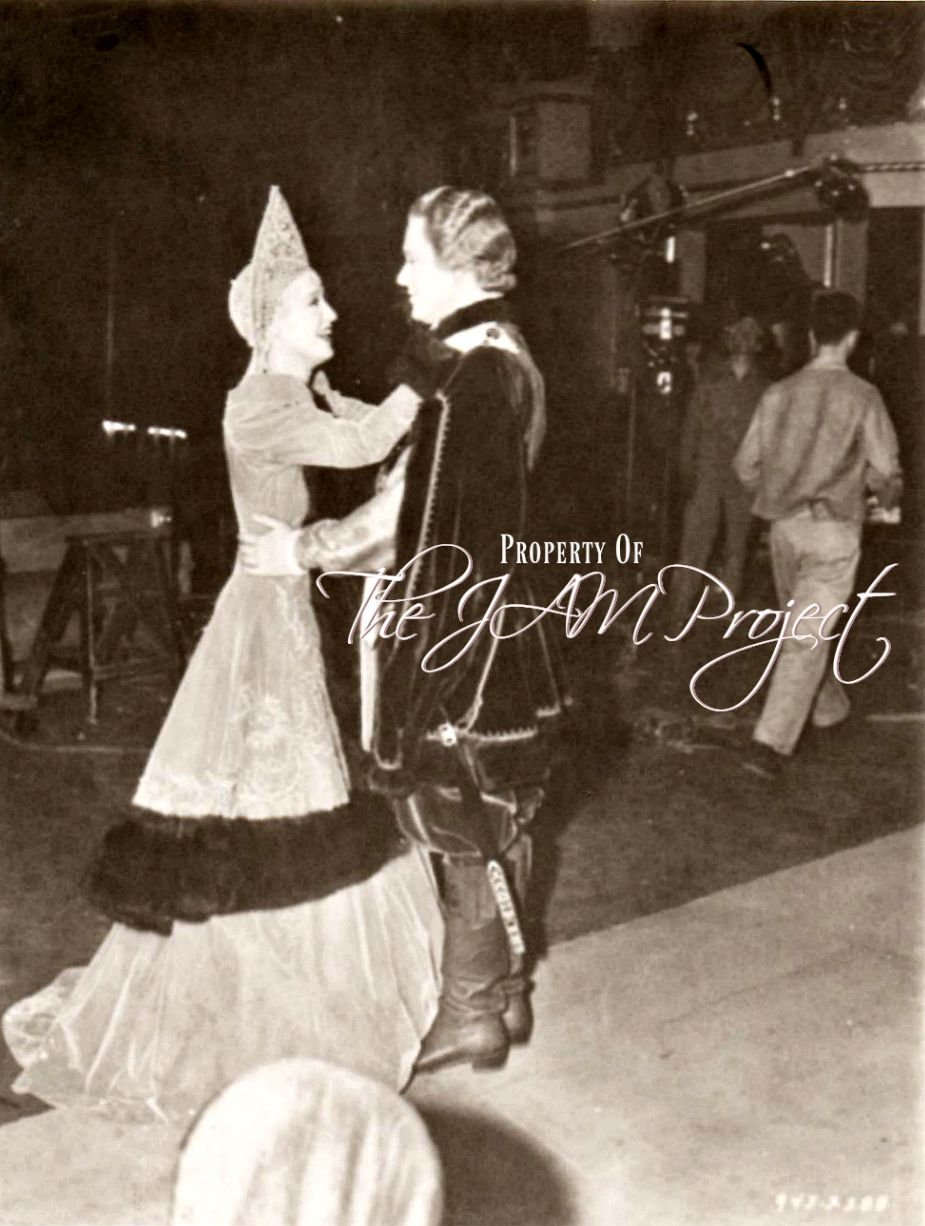
That’s really all I’ve got, on this, right now. No serious research here, just a collection of observations that was too lengthy for a post in the Facebook groups, so here we are. I’ll leave you with a candid photo from the shooting of Czaritza, from the holdings of The JAM Project.

 The Case for Jeanette & Nelson
Leave a reply to Leslie edwards Cancel reply