We’re diving headfirst straight into the chaos, so here goes. If you’re new here, you’ll figure it out as you go along — or you won’t, and you’ll be just as perplexed as the rest of us.
Many readers who have spent some time on this story may be familiar with the fact that Sharon Rich interviewed Susan Nelson, the last nurse who took care of Jeanette in Los Angeles before her death in 1965. Sharon’s interview with Susan is printed in two parts in Mac/Eddy Today issues #54 and #55, and is referenced in Sweethearts. It provided some interesting insight into Jeanette’s last few weeks, as well as some critical details about her living situation.
What I discovered last year, among a huge box of audio cassette tapes that are now within the holdings of The JAM Project, is that the Jeanette MacDonald International Fan Club (JMIFC) ALSO interviewed Susan Nelson in Feburary of 1994. Their interview took place several weeks after Sharon’s, and there’s quite a bit of crossover in the data provided — in fact, having been very familiar with Sharon’s interview, I found the JMIFC interview quite predictable, but it was interesting to hear it all the same, to hear different clarifying questions, and to understand the answers within the context of Susan’s tone of voice and inflection. (I must say, whomever was doing the interviewing on behalf of the JMIFC (and I believe I know who it is) must’ve fully choked because Susan mentioned several times how nice and helpful Sharon had been, how she provided further context and helped Susan get the timeline of her own memories in order, just so nice and positive with no real idea of the in-fighting between the two camps. Entertaining to listen to.)
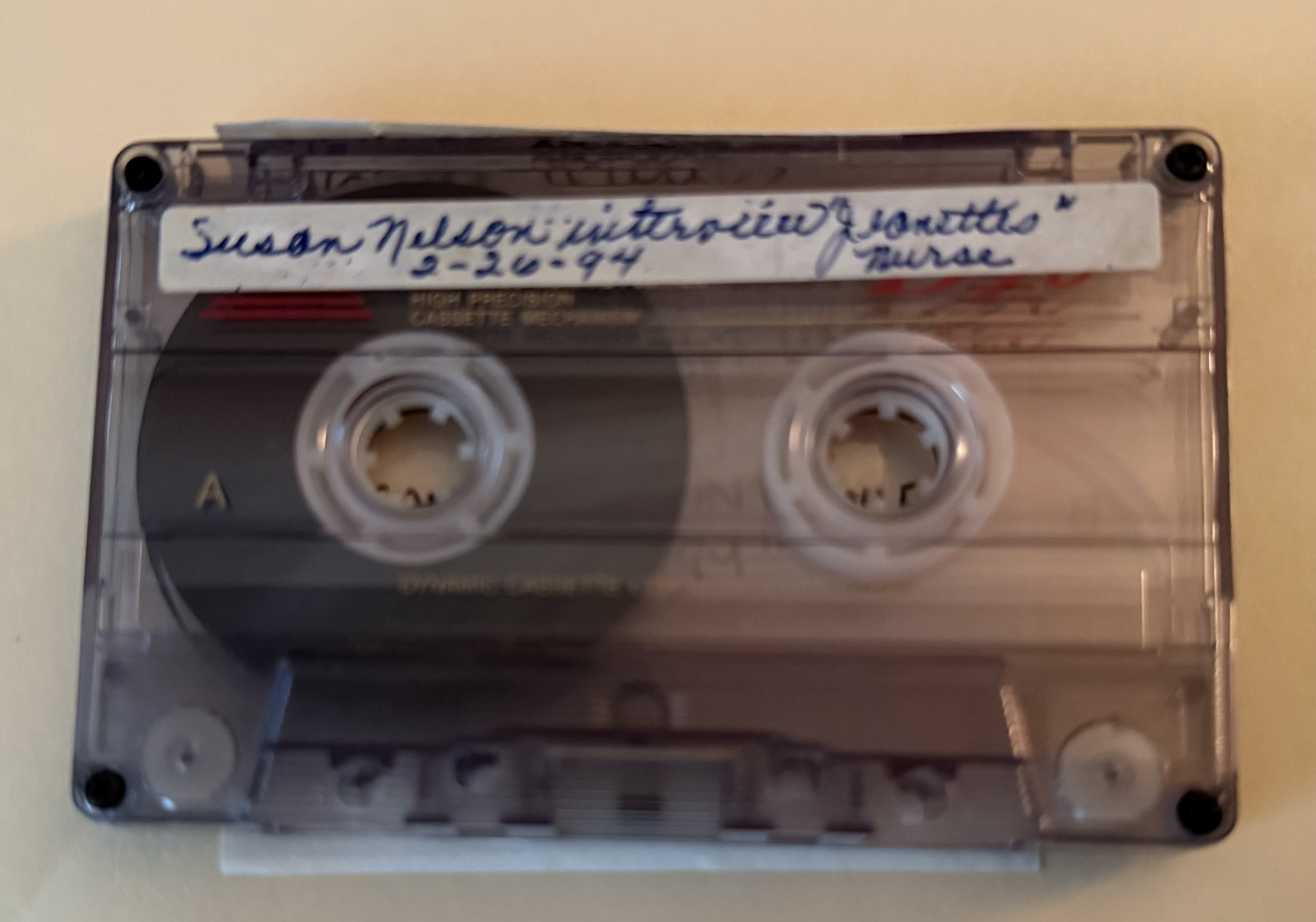
The JMIFC interview is on two sides of a cassette, and the first side details Susan’s own background, how she came to be hired to take care of Jeanette at UCLA over the Christmas and New Year’s holidays of 1964, and her thoughts concerning Jeanette’s condition and personality as well as Susan’s observations of Jeanette’s interactions with Gene Raymond. Side one ends with Susan being engaged by Gene to make home visits to Jeanette’s apartment at the Wilshire Comstock, and her description of that request and the Raymonds’ living situation as she knew it.
Interestingly, side two, wherein, as we know from Sharon’s interview, Susan would describe making the home visits, how Jeanette was being cared for, and her subsequent dismissal by Gene Raymond and his justification for doing so — it has been rendered useless. It’s so muffled as to be inaudible (you can hear that the same people are talking and you can make out every fourth or fifth word — it’s totally maddening), and even after sending the tape to a digitization specialist to try and see if any audible sound can be salvaged from side two, we’re still unable to hear it. As of this writing I have just sent the digital file of the muffled side to yet another person with advanced sound recording programming to see if they can help; I will certainly update this article if they are able to. The cynical side of me wonders if this was not an accident.
Gene gave Susan the impression that he was taking Jeanette to Houston (to the famous cardiac surgeon Dr. Michael DeBakey) immediately, and was in the process of chartering a private plane. Originally he asked Susan to go with them to Houston, and she agreed. Susan understood he was in the midst of trying to get a plane chartered and “at the last minute, I did not go, Mary went, and they flew commercially.” Mary is Jeanette’s housekeeper, not a medical professional. This was, according to Susan in her interview with Sharon, the last she knew until she read about Jeanette’s passing in the papers. For nearly thirty years, she had not understood that there was an eight-day complete lapse in Jeanette’s medical attention. At the time of Susan’s last home visit on January 4th, she attested to Sharon that Jeanette was “too sick to be on a commercial plane” and that she was, for example, taking her to the bathroom during those home visits, which was a change from when Jeanette was in the hospital. She was bedridden, more or less, but in the hospital had been able to get herself to the bathroom. (An aside here is that this may also have been due in part to the fact that hospitals are equipped with handrails and other such accommodations for people who are unwell or recovering, and there is no evidence anything was done in the Comstock apartment to make it easier for Jeanette to take care of herself.) The point was, she was weakening rapidly, and denying her medical attention was heinously inappropriate.
Susan learned from Sharon that Gene did NOT take Jeanette directly to Houston, as he told Susan he was going to do (which was, remember, justification he used for telling her that her services would no longer be needed). Sharon is who helped Susan understand that, after her last home visit to Jeanette on January 4, 1965, it would be a full eight days before she was transported by commercial flight to Houston, where she was pronounced too weak for surgery and died while they were trying to stabilize her. Susan had not previously known of this lapse in the timeline and was palpably sobered to realize it, years later, though it was clear to Sharon, in my recent conversation with her, that Susan did not seem to compute that there could be any willful neglect or wrongdoing afoot. In her published transcript of the interview, she indicated a “long pause” (Mac/Eddy Today, Issue #55, page 48) after Susan was told that Jeanette didn’t make it to Houston until the 12th of January. Sharon said to me, recently, “She was genuinely surprised. She was under the impression that she was dismissed only because Gene was chartering a private plane and leaving for Houston. She didn’t seem to know how to respond to that, hence the long pause that I noted (or with their flying in a commercial plane)…but she thought Gene was a good person. She didn’t seem able to compute why there was so long a time lag, so I didn’t push it.”
By the time the JMIFC interviewed her, Susan had sat with that information for a few weeks. What did she innocently say or ask that would have been preferable to have stricken from the record? I don’t mean to be a conspiracy theorist, but the fact is that this organization has a strong, provable record of censorship of material that doesn’t align with what they’re seeking to perpetuate. I cannot prove that they deliberately messed up the side of the tape that would ostensibly beg at least a few of the many questions any reasonable person would have of Gene Raymond as the de facto person in charge here, but I can prove that one side works and one side doesn’t, and it’s rather convenient which is which. I can prove that that tracks with the way this organization does things. I suppose you may draw your own conclusions, from there, or at least be able to see why I would question it. I mean, the same folks who can’t bear to re-print passages from a 1930s movie magazine that are flattering about Nelson, who attack letters with white-out and give them to biographers to use in their censored form, etc, would certainly balk at a potentially very serious question being asked that could potentially point to willful abusive neglect on the part of Gene Raymond. I can’t prove that this it intentional, but I can sure think it. My hope is that, modern technology being what it is, that we can find a way to undo the damage on this tape and be able to make sense of the audio.
Let’s just say that Gene’s intentions were honorable, that he was working hard to arrange transport, but running into roadblocks. Then you don’t fire the nurse. Or if you do, and then the plans change, you get your ass on the telephone and say, “There’s been a delay, can you keep seeing her while I get it worked out?” OR YOU READMIT HER TO THE HOSPITAL TEN MINUTES AWAY WHERE SHE HAD JUST BEEN A PATIENT. But Gene did none of those things. He just let her rot, with no medical supervision, until it became clear that she was imminent, at which point he puts her on a commercial flight (which made her airsick as usual on top of everything else and which had to be met by an ambulance on the tarmac), and by the time she makes it Houston, there’s no way she can withstand surgery and she dies while they’re trying to get her stable. And Gene looks like the goddamn eleventh hour hero for trying so hard to get her to the hospital — bro, what were you trying to hide that you didn’t take her to UCLA? Why was it the best option to get her far out of town, where the people working on her wouldn’t have had a recent frame of reference to understand how seriously she had deteriorated?
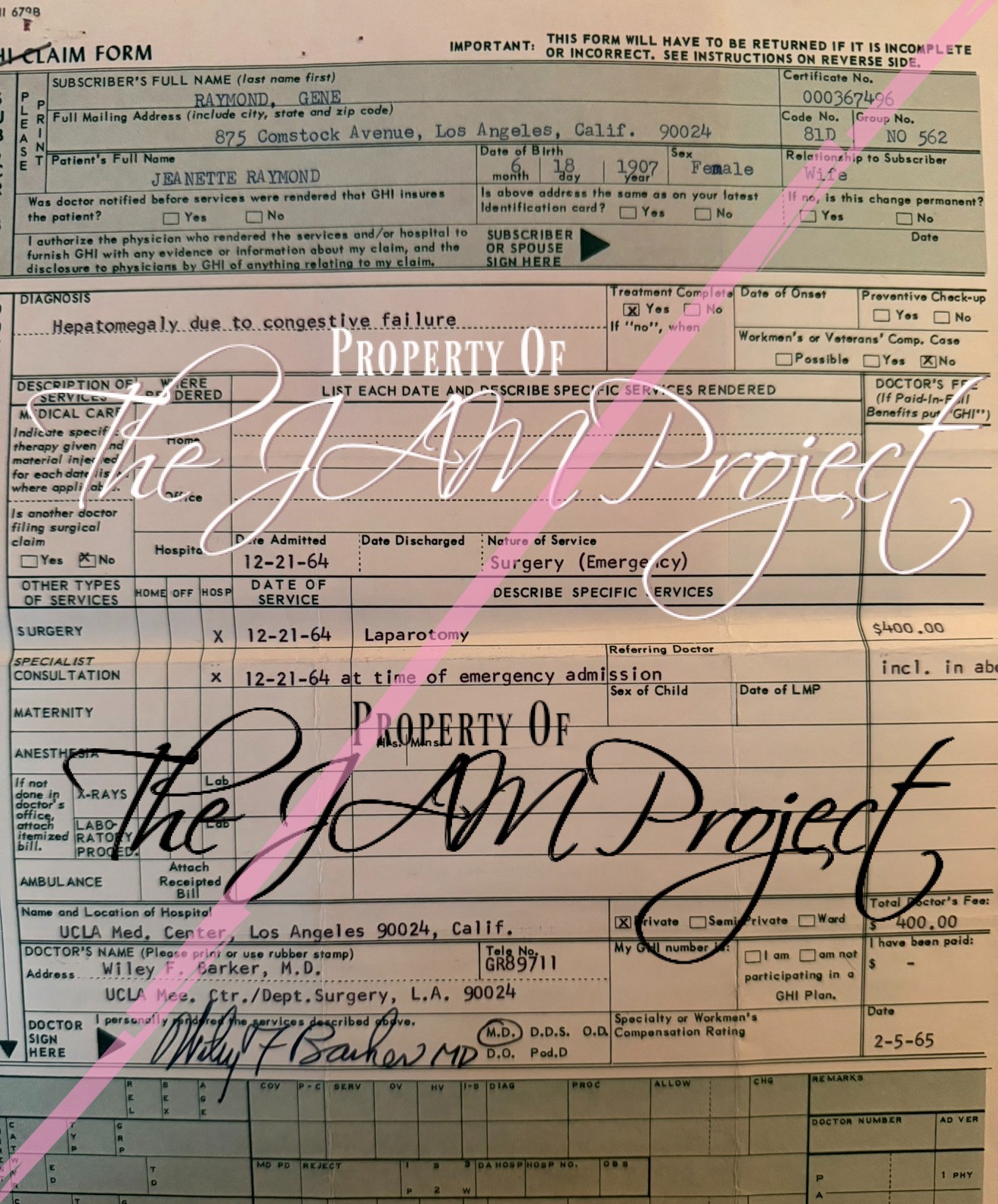
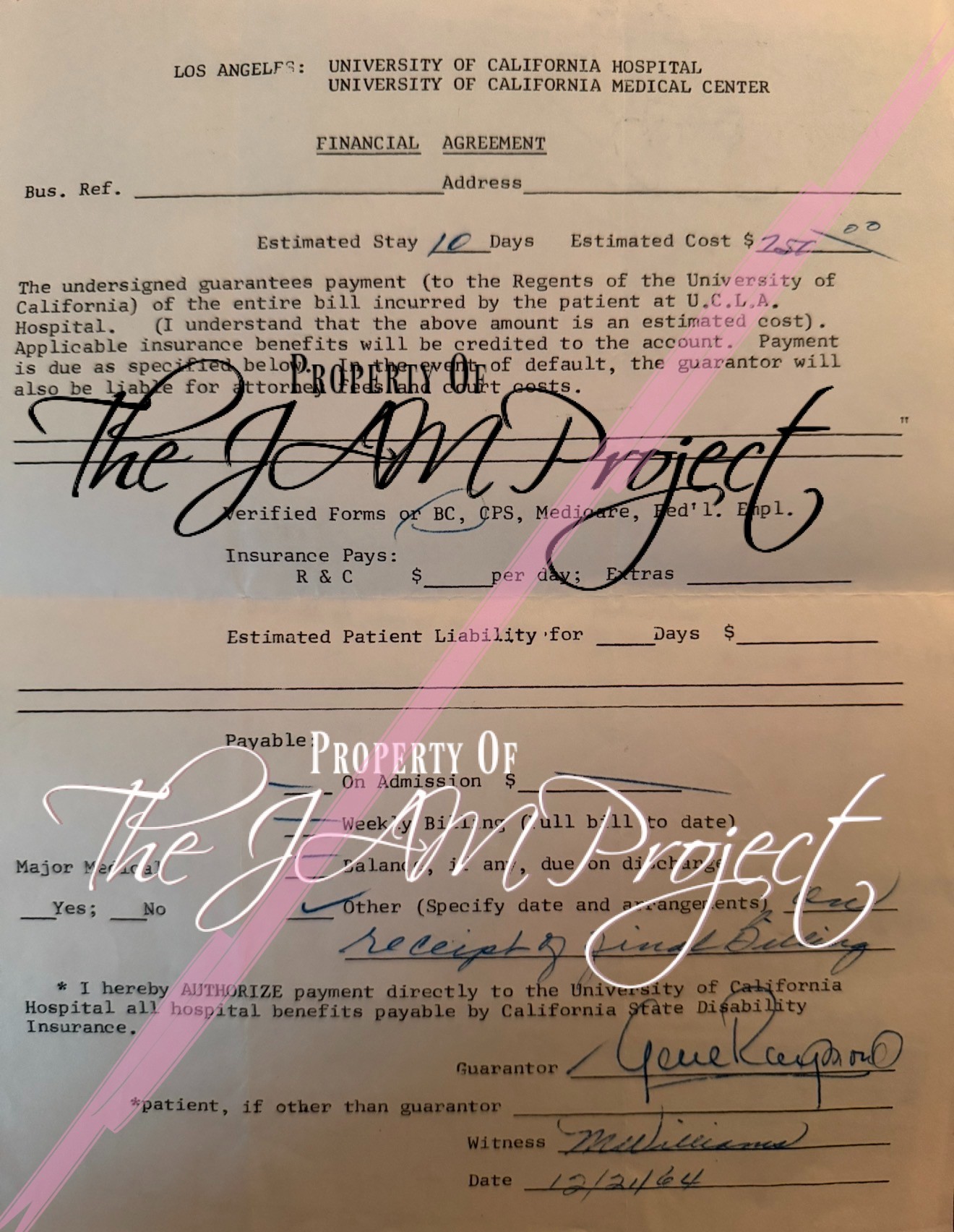
When Jeanette was admitted to UCLA on December 21st, the complaint has long been referred to as “abdominal adhesions.” We are in possession of the insurance claim form (and the financial release form that Gene Raymond signed — you know the one that Nelson searched half the bars in LA to find him to get him to sign for her because they needed it to admit her. Oscar-winning producer Dick Barclay testified that Robert Mitchum verified that story because he was in one of the bars when Nelson came looking for Gene — anyway, we have that form, which is a wild thing to hold in one’s hands, knowing the story behind it), and the actual diagnosis, after a laparatomy (high-risk, urgent opening of the abdominal cavity used to diagnose and treat life-threatening abdominal conditions) performed at the time of her “emergency admission” is “hepatomegaly due to congestive failure” — in layman’s terms, her heart is grossly under-performing and not pumping hard enough to keep things moving, so her liver has gotten backed up with tons of extra fluid (blood) which causes a very swollen and painful liver/abdomen. It mimics things like a bowel obstruction, which is why they immediately opened her up. Jeanette had a recent history of abdominal procedures, an appendectomy in 1957 and in 1961 she was treated again for “subacute” appendicitis (which can happen if tissue or the “stump” left behind from an original appendectomy becomes inflamed) as well as a uterine fibroid, and the scar tissue left behind from these would have made “adhesions” the immediate suspicion. The official diagnosis, though, is that her dying heart was responsible. This was the last and most dangerously significant warning. Her UCLA procedure was performed by Dr. Wiley Barker, who was very well-known, easily researchable, and was one of the leading vascular surgeons anywhere at the time. She was in good hands that December 21st at UCLA, and, though she was very ill, she was lovely and adorable and present (and able to get out of bed under her own steam on a very limited basis) when Susan began taking nursing care of her. If only she had gotten to DeBakey sooner, it seems likely that she would have had a much better chance of withstanding surgery. It remains utterly baffling that this was allowed to take so long.
I don’t even want to fathom what those days at home must have been like for this strongwilled, spirited, has-her-shit-together lady. I try to stay away from that space because it’s cripplingly depressing. Susan confirmed that she did not have a telephone in her bedroom so she wouldn’t be “bothered” — but that also makes it so she can’t reach out.
Emily West, longtime MacDonald secretary and companion, was only around sparingly during this period. Her 1965 datebook/desk diary reveals only sparse notes about Jeanette in January, and many entries about the apartment building she was managing, the Marietta (yes, lol) Apartments, as well as quite a number of dinners and other social engagements (??????? Jeanette is dying, needs someone there, and you’re going out to dinner???). She does indicate that Jeanette was released from UCLA on December 31st, and on January 2nd, makes a note that “Jeanette [is] not at all well.” Right there, another indication that perhaps she should not have been at home. But in just forty-eight hours, Gene Raymond deems it appropriate to discharge the nurse?
I will leave this right here, a page out of the 1965 datebook, during this critical period. Emily notes on the 3rd that Jeanette had slept better the night before, and on the 4th there’s a notation about Dr. Rose at 5PM. Dr. Rose was one of Jeanette’s attending and I would assume based on the hour that this was to be a house call. There is a shorthand notation beneath it, and it translates to the appointment being canceled or postponed. On the same day that Gene dismissed Susan Nelson, the nurse?! Something stinks. Bad.
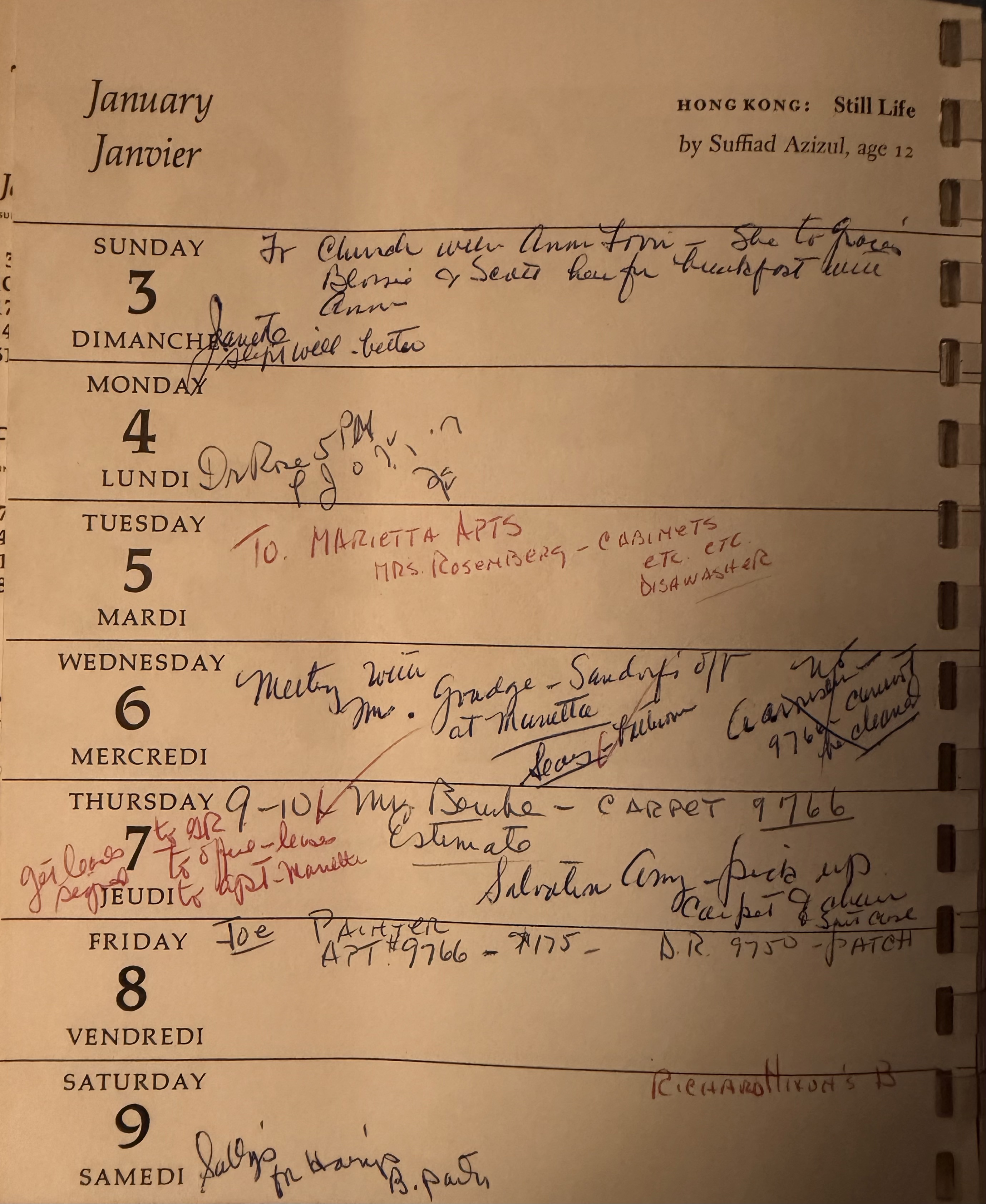
The rest of Emily’s week is filled with apartment management stuff and social engagements — while Jeanette sat at the Comstock, deteriorating rapidly, and nothing was done about it. She needed the nurse’s help to get out of bed to get to the bathroom on the 4th. What shape was she in on the 11th? It gives me actual heart pain to even try to comprehend the gravity and isolation of her situation. Susan says that Mary fed and bathed Jeanette. Sharon interviewed the Comstock doorman years later who attested that he was recruited to carry Jeanette to the car for that ill-fated trip to Houston. Gene seems very adept at getting out of any sort of “icky” situation involving emotions, physical care, or doing hard things with someone to whom you’ve made a for better or worse, in sickness and in health vow. Jeanette didn’t weigh much of anything at this point; she cannot have been hard to carry. But Gene treated her like a piece of baggage he needed the bellhop to collect. Could that be guilt? He can’t get too up close and personal with the suffering to which his negligence is contributing? I find him despicable.
Moving on, something that came to light in the JMIFC interview with Susan Nelson, that was different than the Sharon Rich interview, was a comment that Susan Nelson made concerning her awareness of the existing relationship between Jeanette and Dr. Michael DeBakey. It was in Jeanette’s chart, and she heard Gene discussing Debakey with Jeanette when he was in the hospital room with her. Susan made the comment that, “I knew they had had a prior relationship with Dr. DeBakey, and I knew that if they wanted one again, it would be readily available with one phone call from Mr. Raymond to Dr. DeBakey — he would get right through to the doctor in Texas. That much I knew, from being her nurse.”
I must say that for me, this really strengthens the question of why the hell wasn’t something done sooner? Yes, Jeanette did have a previous association with DeBakey, and indeed, in Houston. November 1, 1963, she went to Deane Johnson’s office to sign what would be her last will, and from there boarded a plane to Houston, where she underwent an arterial transplant procedure done by DeBakey that would ultimately (including complications afterwards such as pleurisy), leave her hospitalized in Houston for nearly four months. This is well-documented. What perhaps is unknown, except to the very small group of us who have studied Jeanette’s 1963 Desk Diary in its complete form, is that, prior to that November 1 trip to Houston, Dr. DeBakey was in Los Angeles. On Saturday, October 26th, at ten o’clock in the morning, Dr. DeBakey and two of Jeanette’s LA doctors met for a conference at her Comstock apartment, obviously to compare notes and prepare for the upcoming procedure. It’s entirely possible that DeBakey was in LA on other business and the meeting was an add-on, but even so, Jeanette and her case were important enough to warrant the foremost heart surgeon in the country meeting with her and her doctors at her home on a Saturday, and that was about fourteen months previous to this. It wasn’t like this was ancient history. Between the provable history on paper and the testimony of Susan’s awareness of the existing relationship–this taking until the 12th of January is absolutely inexcusable.
And I’m so entirely effing sorry — a Colonel (was he a Colonel by 1965? No? Yes? He was when he retired three years later; at any rate he’s got over twenty years in the service at this point) in the goddamn Air Force can’t find ONE PERSON to get her to Houston faster, if she has to go? Please. Small private jets were a thing by this time. But no, Mr. Air Force can’t figure this one out, and is far too willing to take no for an answer while Jeanette is actively dying in the other unit of their Comstock situation.
Speaking of the Comstock, Susan Nelson made a couple other remarks in her JMIFC interview that were very revealing. She had already noted (in both interviews, I believe) that Gene was at the hospital on a daily basis, that he brought Jeanette the Christmas cards that had arrived from their friends, and that her observation was that he was a caring spouse. So it isn’t as if she had any agenda about Gene or any of this at all; she’s simply reporting what she knew from her lived experience. Remember, she sort of “failed to compute” when Sharon had to let her know that there was an eight day lapse between her being dismissed and Jeanette’s transport to Houston — and at least during Sharon’s interview had not grasped that anything negligent could have been going on, because it didn’t jibe with the experience she had. So with that in mind, there’s zero reason to think she’s being anything other than completely honest, here. She says that Gene asked her to make home visits, and she agreed, and then she begins to describe where they Raymonds lived. She correctly names the location and says she thinks they lived on the eighth floor, it seems to her (yes, she’s correct, units 8C and 8D). So with that, I give you this:
“Mr. Raymond explained that Jeanette had a housekeeper named Mary, and she lived with Mrs. Raymond, and she was there all the time. I went the next day, and Jeanette lived in an apartment that had two bedrooms; she had a bedroom and Mary had a bedroom. They had broken a door through, and Mr. Raymond lived in the apartment next door.” At this point, the JMIFC interviewer (whom I would strongly bet was never inside the Comstock) feels the need to jump in and correct Susan that it was “just a big apartment”.
Jeanette’s 1963 desk diary is full of notations about things being done for “GR side” or “my side” — for what it’s worth. She softens that separation when writing for the fan club, calling it a “double apartment” but the fact is that they had two kitchens, two living rooms, two dwelling spaces. One night in 1963 she recorded that she “made mistake of going to GR’s bed — with indifferent results.” I’m not going to speculate on whether she was going to make an attempt at initiating sex or simply the intimacy of lying next to another warm body amid a whole lot of uncertainty in her life, but the point is GR’s bed was not the same as JAM’s bed. And it never was. They fully had separate bedrooms and bathrooms at Twin Gables, too. We have letters to Lotte Lehmann from Jeanette detailing Lehmann coming to visit (with partner Frances and dogs Fritzi and Mausi in tow), and Jeanette putting them, together, in Gene’s room. (Fully inviting them as a couple and being cool as shit about it; this ally queen.) Her allergies and sensitive sinuses could never have dealt with his continuous, heavy smoking in her sleeping space. They had entirely different sleep schedules and habits. They had entirely different morning personalities. When Gene came to visit Jeanette on the set of The Sun Comes Up, she had to switch accommodations with someone because her husband was coming to visit and she needed an extra bed, something the uprooted party found curious but didn’t question the star about. I’m not saying they never “did” anything — but I am saying that the Comstock arrangement was simply an extension of what they’d been doing for more than a quarter century already: living in harmonious (?) indifference, under one roof, but two ceilings. (And actually, come to think of it, between tours, the war, location work, and other travel, they lived under two roofs more often than not, anyway.) It’s just interesting to me that the commitment to perpetuating this sickeningly sweet marriage narrative is so deeply entrenched in these people that the knee-jerk reaction is to correct Susan’s recollections of her own LIVED EXPERIENCE and insist that it was just one big apartment. That wasn’t her experience, nor was that what Gene told her when he was asking her to make home visits. So like, have several seats.
As for Mary, the housekeeper — she is an interesting character. We are in possession of a 1966 letter from her to Clara Rhoades, wherein her distress a little over a year later is still plainly evident, as are her feelings about Emily West and Gene Raymond, who was still her employer at that time. She was a housekeeper and occasionally a cook, she was not a home health nurse or any type of medical professional, yet she was tasked with the day in and day out care of a terminally ill woman, while Emily went out to dinner and Gene carried on his own affairs in his adjoining apartment. Mary suffered a breakdown after the events of January, 1965, saying that she “helped kill Jeanette” by her compliance. Her English is not fantastic, and I’m unsure if this is due to English not being her first language or merely a lack of education, but her nine-page letter to Clara paints an unflattering portrait of the world she’s living in, post-Jeanette, whom she loved.
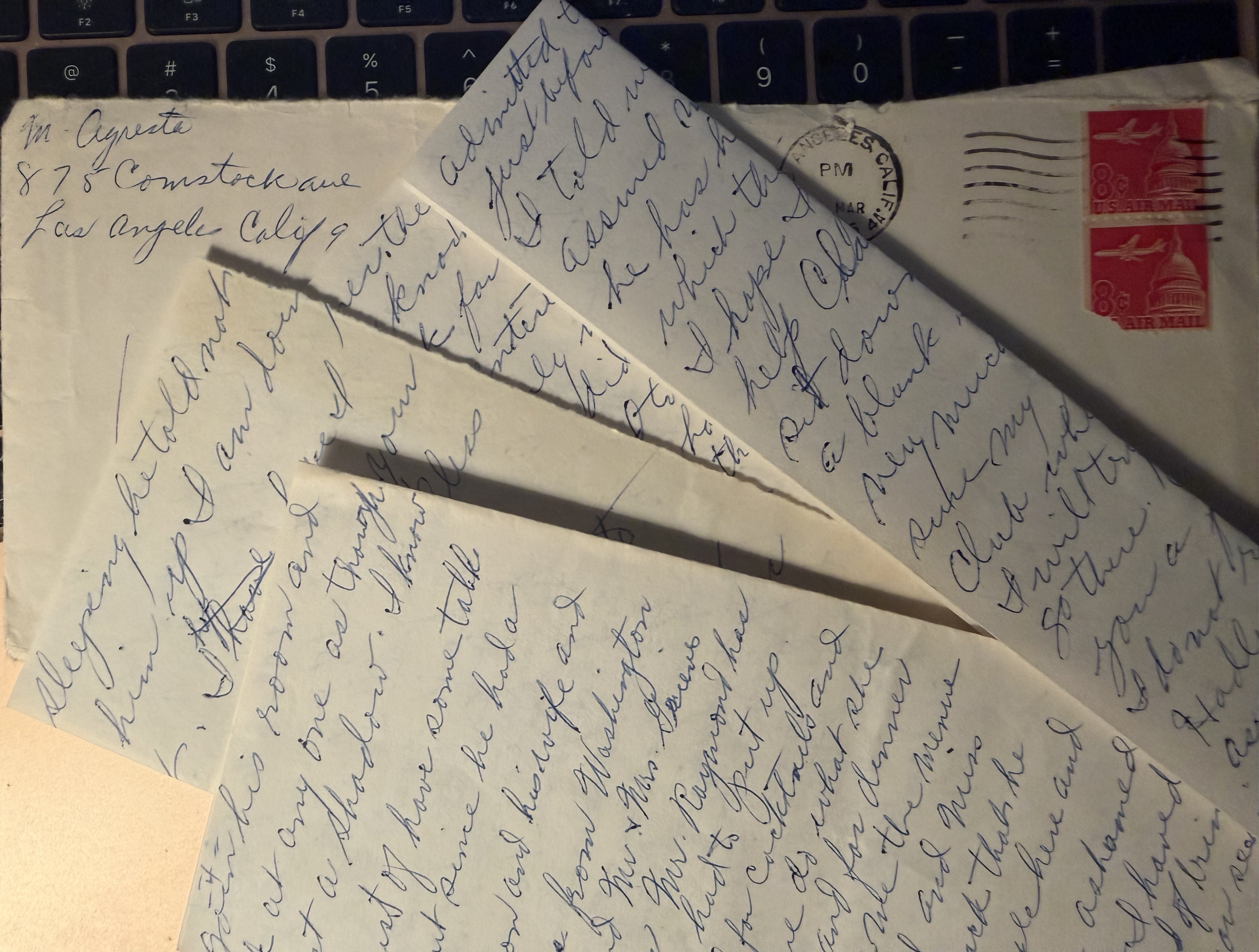
When Jeanette was in her final illness, Mary says that the expense of the phones and intercom system through the apartments was costing $50/month, and that Emily called the phone company and had them removed. “At the time, no one had there[sic] thinking head on and of course I was not asked anything so I could not say anything. Now when I am in my room I do not here[sic] his [Gene’s] intercome[sic] and I have to hang around all day to listen when he calls me.” This is indicative of her tone throughout; she was primarily Jeanette’s employee and there is very little consideration of her from Gene or Emily. This change was an inconvenience, and another problem was that Mary had so much to do and so many things to attend to but “if I go in my room in the afternoon it is so hot in there that it is sicking[sic]. They left the phone in the kitchen which does no good to me. They should have left one in my room, but this is enough about me.” She also says that for all the waiting around to hear when Gene might potentially need her, she spoke to him about five minutes a day. The rest of the time he was out, on the phone or closed up in his apartment. And it sounds like the climate-control in Jeanette’s apartment was pared way down since it was just “the help” living there and obviously she didn’t need to be comfortable.
“As you said Clara, they all have there[sic] own trouble, but I don’t want to be left in the dark and they just know you when they have some dirty work to be done and call you.” WHOA.
“Miss Wentz is all business and what she cares to do or be with.” (I translate this as Emily does what she wants and the hell with anyone else.) “Mrs. Rock is up in years, which I understand, and the last two times I was there I got to understand her more. They are both doing things they do not want the other to know for fear of feeling[sic] are hurt.”
“As far as Mrs. Raymond and Mrs. Rock [and] Mrs. Scheiter[Elsie], they were 3 sisters but three different chartar[sic]. And of course she was the best.” ❤ ❤
Mary goes on to describe being asked to put together a small dinner party at the Comstock. “For dinner Mr. Raymond gave me the menu what he wanted and Miss Wentz made a crack that he want to bring people here and did not want to be ashamed. I do not know what I have done for him to be ashamed of bringing his friends here.” Ew, Emily. They gave her a bit of a hard time about putting together this dinner, but she says that since moving to the Comstock they had not entertained, because Mrs. Raymond was too sick. “We only had people here twice.” She really didn’t know what Gene would have wanted because when she was in charge of the meals (which wasn’t always), “he use[sic] to eat what she wanted and I know that he want more and everything was so flat but of course he would go out and get what he wanted and never said anything to her.”
She talks about how Gene is often MIA and doesn’t say where he is going or what he’s doing, and when he comes home he usually just wants to sleep. She doesn’t know if he’s returning phone calls or answering mail. “When he is out, I do not know what he does, but Mrs, Rock once said I don’t know what my sisters think but there[sic] husbands are no better than Rocky.” [Rocky was a known philanderer and they were all but divorced before his cancer diagnosis and Blossom made the choice to take him back and ride that out with him until his death. I find it hilarious that Blossom is telling Mary that they’re all a bunch of schmucks.] Mary also speaks about Gene’s drinking and how when he’s home he only takes “one or two drinks before dinner” but she suspects that he drinks a lot, and definitely with Mr. Scheiter.
Mary closes by thanking Clara for allowing her granddaughter to be in the club, and asking her to keep some of these things in confidence — well, trust that Clara kept ALL of it in confidence because none of it paints a flattering picture of two of the main characters! But also — Mary is old enough to have a granddaughter old enough to enjoy being a member of the JMIFC, so on top of not being medically qualified, being too close to the situation and obviously upset by it, this is not a young woman who was charged with doing her best to handle Jeanette’s hospice-type care.
I include this because it adds further context, and demonstrates the inconsiderate way Gene and Emily handled someone they consider to be their inferior, but Mary clearly loved Jeanette and seemed to like Blossom pretty well, too. And, more importantly, Clara Rhoades knew GOOD AND DAMN WELL that a shitload of what she was perpetuating was an absolute raging lie and a myth. Jeanette does not have to be sleeping with Nelson Eddy for ANY of the aforementioned points to hold water. Gene was a lousy loser of a human being, weak and checked out at best; downright malicious at worst. He was an appallingly poor partner. Jeanette often wrote of the “shell” around Gene; how she couldn’t cry in front of him, how he accused her of being “female” and trying to emotionally manipulate a situation. Gene didn’t do feelings well, and certainly not tenderness. Jeanette thrived on tenderness. Gene was for damn sure not man enough to step up and step in when it came to her care, no, that was everyone else’s job, or it could just not happen at all, while he fucked around until 11:59:59 figuring out how to get her to Houston when planes were like the one thing he supposedly did well.
I am so sorry, Jeanette. This sucks. I didn’t even address everything that I wanted to. I wanted to talk about what Susan said she was like, how gracious and lovely and perfect she was, how she never complained, wasn’t high maintenance, how pleased she was with her Christmas cards that came in droves, how she was delighted to find out that Susan was pregnant. I got into the weeds of her medical files last night and interspersed with the paperwork are multiple letters of condolence from doctors and clinic staff to Gene, saying how much they loved her, and what a great and wonderful lady she was. But I honestly don’t have anything left in the tank, after days and days of working on this article, to go into all of the nicer stuff. I wanted to talk about Jeanette’s habit of making conversations with people she doesn’t know all about the other person; a charming behavior in a movie star to be sure, but also a time-perfected method of not inviting too much personal inquiry about herself. Jeanette was good at the art of people, and had a most loyal following for decades. She was an expert at putting others at ease, and taking the attention off of herself; hell, she didn’t even want to discuss her health with her nurse, nor did she ever mention any discomfort or concern about herself or her situation. Susan experienced that MacDonald Deflective Charm in full measure, and it led to her very positive opinion of this nice lady and her nice husband.
If only she had known more. Dug more. Asked more. But it was a different time, and she was a young woman doing her job. She is by no means a heavy in this story, but she also didn’t have the tools or the knowledge to spot the heavies all around her.


Leave a comment